
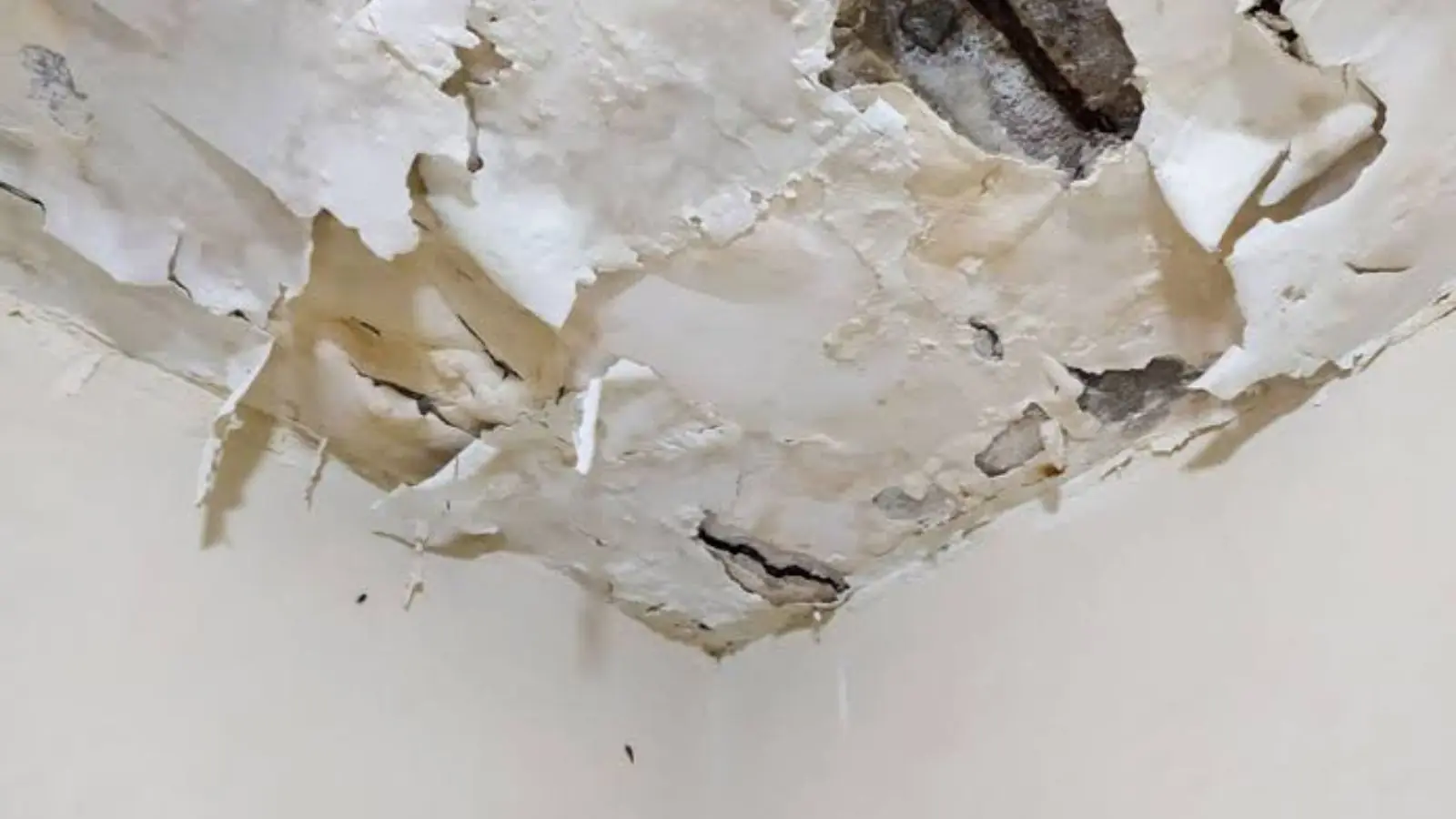
Ceiling water damage repair services in Duarte, CA come from at least three different trades, and calling the wrong one first costs time while the drywall keeps absorbing water. A plumber fixes pipes, a roofer fixes the roof, and neither one dries your house. A restoration company dries it, and a drywall or painting crew puts the ceiling back.
The sequence is simple once you see it. Stop the water, dry the structure, then repair. The table below shows who owns each step, followed by what to expect from a restoration visit and how to check any contractor before you sign.
Who handles what
| Problem | Who to call | What they do | What they do not do |
|---|---|---|---|
| Leaking supply or drain line | Plumber | Finds and repairs the pipe, fixture or seal | Dry wet framing, insulation and drywall |
| Roof or flashing leak | Roofer | Repairs shingles, flashing or vents, may tarp temporarily | Remove wet attic insulation or dry the ceiling |
| AC condensate overflow | HVAC technician | Clears or replaces the drain line, checks the pan and float switch | Dry the ceiling below |
| Wet drywall, insulation or framing | Water damage restoration company | Extracts water, maps moisture, sets air movers and dehumidifiers, removes materials that cannot dry | Fix the plumbing or roof itself |
| Mold growth after a leak | Mold remediation contractor | Contains, removes and cleans following ANSI/IICRC S520 practice | Diagnose health effects |
| Sagging, missing or patched ceiling | Drywall contractor, painter or general contractor | Replaces board, matches texture, primes and paints | Dry out the structure behind the board |
| Sparks, burning smell, wet fixture | Electrician, and 911 if there is danger | Tests and repairs wiring and fixtures | Water extraction or drying |
What a restoration visit includes
A good water damage visit follows the ANSI/IICRC S500 standard, which is the published industry standard for professional water damage restoration. Ask any company whether it follows it and how it records its readings. A typical visit has these parts, and the order can shift with the size of the loss.
- Inspection and moisture mapping. A moisture meter and thermal camera trace the wet area on the ceiling, walls and floor, then mark it on a sketch so progress can be measured.
- Water removal. Extraction units and wet vacuums remove standing water from floors and carpet, which cuts the drying load.
- Removal of materials that cannot dry. Soaked insulation and sagging or soft drywall usually come out so the framing can dry.
- Structural drying. Air movers push dry air across surfaces and LGR dehumidifiers pull moisture out of the air. Equipment placement follows the moisture map.
- Monitoring. Technicians return to take daily moisture readings and adjust equipment until the materials reach a dry standard.
- Written scope and records. You should get a document listing what was done, readings and photos. Insurers often ask for these, so keep your copy somewhere you can find it later, along with the final drying readings.
That process is what water mitigation means in practice. It is separate from the cosmetic repair, and it should finish before drywall goes up. Ask how many air movers and dehumidifiers the crew plans to place and why, since equipment counts should follow the size of the wet area and not a flat package.
Unsure which trade you need first?
Call the 24/7 line. Describe the stain and what you have already tried, and dispatch will tell you whether to start with a plumber, a roofer or a drying crew.
What happens after the drying is done
Drying ends when readings show the framing and remaining drywall are back at the dry standard, not when the equipment has run for a set number of days. At that point the crew pulls the equipment, and you get the final readings and photos.
Only then does the rebuild start. A drywall crew hangs and tapes new board, a painter primes with a stain-blocking primer and matches texture, and the whole ceiling plane is painted so the repair does not show. If permits apply, the person doing the work should say who pulls them. Closing a ceiling before it is dry is the most common reason a stain returns.
How to check any contractor
- Ask for a CSLB license number and look it up. California requires a license for work totaling $1,000 or more in labor and materials. The number must appear on the contract, and you can verify it on the Contractors State License Board website. Our crews are licensed and insured, and you should expect every company to say the same and show proof.
- Watch the down payment. Per LA County Consumer and Business Affairs guidance, a down payment should not exceed $1,000 or 10 percent of the job, whichever is less.
- Ask what standard they follow. For water, that is ANSI/IICRC S500. For mold, ANSI/IICRC S520.
- Get a written scope. It should list rooms, materials to be removed, equipment, monitoring visits and what the job does not include.
- Ask who does the rebuild. Some companies dry and rebuild, others dry and leave. Know which one you are hiring before work begins, and whether the quote covers drying only or the full return of the ceiling to paint.
- Check for pressure. Be wary of anyone who wants you to sign a work authorization before they have taken a single moisture reading.
For mold remediation, California has no legal training, licensing or certification requirement for mold assessors or remediators, according to the state public health department. That makes the standard and the written scope your protection, so ask for both.
Duarte local note: emergency numbers and service numbers
If a wet ceiling comes with sparks, a burning smell, or someone injured, call 911 before calling a restoration company. LA County Fire Station 44 is at 1105 Highland Avenue, (626) 358-3118, and the Duarte Sheriff satellite station is at 1042 Huntington Drive, (626) 357-7938, for non-emergency questions. Save those numbers next to your plumber so you do not hunt for them at midnight.
The City of Duarte main line, (626) 357-7931, can route permit questions. Drywall replacement needs a building permit according to the city FAQ, so ask whoever you hire whether they are pulling it.
Sources: city website, CSLB, LA County DCBA
Serving nearby neighborhoods
Crews also take calls in Monrovia, where the city runs its own water and sewer, and in Arcadia, where the Building Services Division handles permits. For a project that crosses a city line, ask your contractor which agency applies to your address.
Questions Duarte homeowners ask
Call the plumber if a pipe is actively leaking, because nobody can dry a house that is still getting wet. Call a restoration company at the same time if the drywall is wet, since drying should start within 24 to 48 hours. The two trades do not overlap.
Usually not. Roofers fix and tarp the roof. Wet attic insulation and the framing under it are a drying job for a restoration crew with moisture meters and dehumidifiers.
It is a published standard that sets professional practice for water damage restoration. You are not expected to know the details, only to ask a company whether it follows it and how it documents readings.
Some can, and a single scope avoids gaps between trades. Ask whether the rebuild is done by the company's own crew or a subcontractor, and get that in writing with the license number.
Call 911 first for sparks, burning smell or injuries. For urgent but non-emergency questions, LA County Fire Station 44 on Highland Avenue is at (626) 358-3118. Once the power is safe, call a restoration company to start drying.
Use the CSLB website and enter the license number from the contract. The license should be active and match the company name. California requires a license for work of $1,000 or more in labor and materials.