
Choosing a mold removal company in Duarte, CA is harder than it should be, because the state does not set the rules for who can call themselves a mold specialist. California has no legal requirement for training, licensing or certification of mold assessors or remediators, according to CDPH. That puts the work of screening on you.
The good news is that a handful of questions sorts careful companies from careless ones fast. Use the checklist below with any company in the San Gabriel Valley, including us.
Start with the standard
Since there is no state mold license, ask the first and most useful question. What standard do you follow? A solid company will name ANSI/IICRC S520, the published Standard for Professional Mold Remediation. It is a published industry standard, not a license, and naming it does not prove quality. But a company that cannot name any standard is telling you something.
For the water side of a job, the companion standard is ANSI/IICRC S500. Both are public references, and you can ask any company how it applies them on a job like yours.
| Question | Good answer | Red flag |
|---|---|---|
| What standard do you follow? | Names ANSI/IICRC S520 and explains how it applies to your job. | No answer, or "we have our own method". |
| Can I get a written scope? | Yes, itemized by room, material and method. | A verbal quote or a single line total. |
| How will you contain the work? | Plastic barriers, zipper doors, negative air with HEPA filtration. | "We just spray it" or no containment mentioned. |
| How do you verify the work? | Moisture readings, visual walkthrough, and openness to independent testing. | "Trust us, it is gone." |
| Are you licensed and insured? | Yes, and shows the CSLB license number on the contract. | No number on the contract or evasive about insurance. |
| What is the payment schedule? | Down payment within the California limit, balance tied to progress. | Large upfront payment or cash only. |
| What if more damage is found? | Written change order before extra work. | Extra work added without sign-off. |
Print the table and take notes during each call. Companies are often more careful once they realize you are working from a list.
Licensing, insurance and the contract
Mold removal that includes demolition and rebuild is construction work. California requires a contractor license for jobs of $1,000 or more in labor and materials, as the CSLB sets out. The contract must show the CSLB license number, and you can check that number on the CSLB website. Look at the license status, the name on it, and whether it matches the company on your paperwork.
Insurance matters too. Ask for proof of general liability coverage and, if workers are on site, workers' compensation. Our crews are licensed and insured, and you are entitled to ask any company to show you.
Written scope and containment
A written scope should say which rooms, which materials come out, how the area is sealed off, how it is cleaned and how it is checked. A vague scope like "remove mold" leaves too much room for dispute.
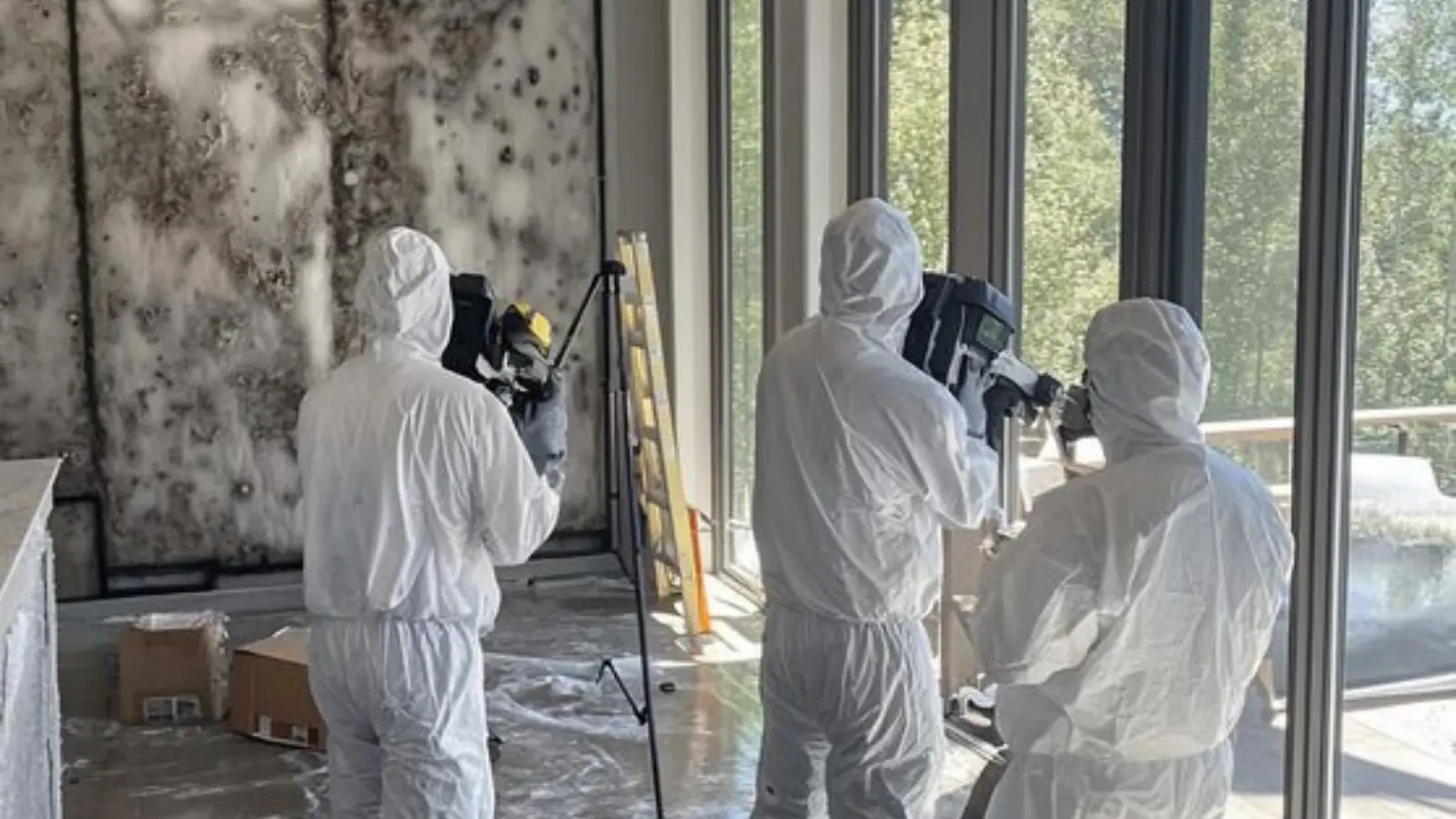
Containment is worth asking about directly. Plastic sheeting seals the work area, and a HEPA filtered air machine keeps air moving inward so dust does not spread to clean rooms. If a company plans to demolish a moldy wall with no barrier, move on.
Comparing companies right now?
Call the 24/7 line and ask us the same questions you are asking everyone else. We will answer them directly, including what we do not do.
Post-work verification and independent testing
Every company should have a way of confirming that the work is done. At minimum that means moisture readings showing the structure is dry, a visual check that surfaces are clean, and a walkthrough with you before rebuild.
Some homeowners also want independent clearance testing. This is an optional, separate step, and it is best done by a different company than the one that did the removal. The reason is simple.
The company doing the work should not be the one grading it. There is no state mold exposure limit, per CDPH, so a test result is only useful when it is compared against a clear plan and a clear baseline. Ask the tester what they compare against before you pay.
Ask about the crew and the cleanup
Ask who will actually be in your home. Some companies sell the job and hand it to a subcontractor, which is not wrong in itself, but the license and insurance on the contract should cover whoever does the work. Ask how debris is bagged and carried out, how HEPA vacuums are used on the last pass, and whether the crew will walk the finished area with you before they pack up.
Red flags to walk away from
- A price quoted before anyone has seen the damage.
- Pressure to sign today.
- No written scope or no license number.
- A large down payment. LA County DCBA guidance says not to pay more than $1,000 or 10 percent, whichever is less.
- Promises that mold will never return. No honest company can say that, because mold needs moisture and the moisture source has to be controlled.
- Health claims or diagnoses. Health questions belong with your physician.
If the problem began with a leak, the first step is usually drying, which falls under water mitigation. Mold work that follows is covered on our mold remediation page. Ask each company how drying and remediation will be coordinated so nobody leaves the structure wet.
Duarte local note: license rules and the standard question
Because California does not license mold remediators as such, the CSLB license and a named standard are your two best filters. The LA County DCBA guide adds that the contract must show the CSLB license number and that mold cleanup must follow EPA and Cal/OSHA rules. Ask the company how it meets both.
For a quick check, write down the license number from the contract and look it up on the CSLB website before you pay anything. If the name or status does not match, call the company back. If you are unsure about a permit for demolition, the City of Duarte Community Development counter can tell you what applies at (626) 357-7931.
Sources: CDPH, CSLB, LA County DCBA, city website
The San Gabriel Valley angle
Companies near Monrovia and Glendora advertise heavily, and many of them serve Duarte too. The checklist works the same no matter which city is on the truck. Get two or three bids, keep the scopes side by side, and choose the company that explains its work most clearly, not the one that sounds most certain.
Questions Duarte homeowners ask
No. CDPH says California has no legal requirement for training, licensing or certification of mold assessors or remediators. Contractors doing construction work of $1,000 or more still need a CSLB license.
ANSI/IICRC S520 is the published Standard for Professional Mold Remediation. It is an industry standard, not a license, but it gives you a common reference for asking how a company works.
Independent clearance testing is optional, and it is best done by a different company than the one that removed the mold. That keeps the grader separate from the worker.
Look up the license number from the contract on the CSLB website. Confirm that the name, status and classification match the company you are hiring.
Call the Community Development counter at City Hall, 1600 Huntington Drive, at (626) 357-7931 ext. 230 or 235. The city says drywall replacement needs a building permit.