
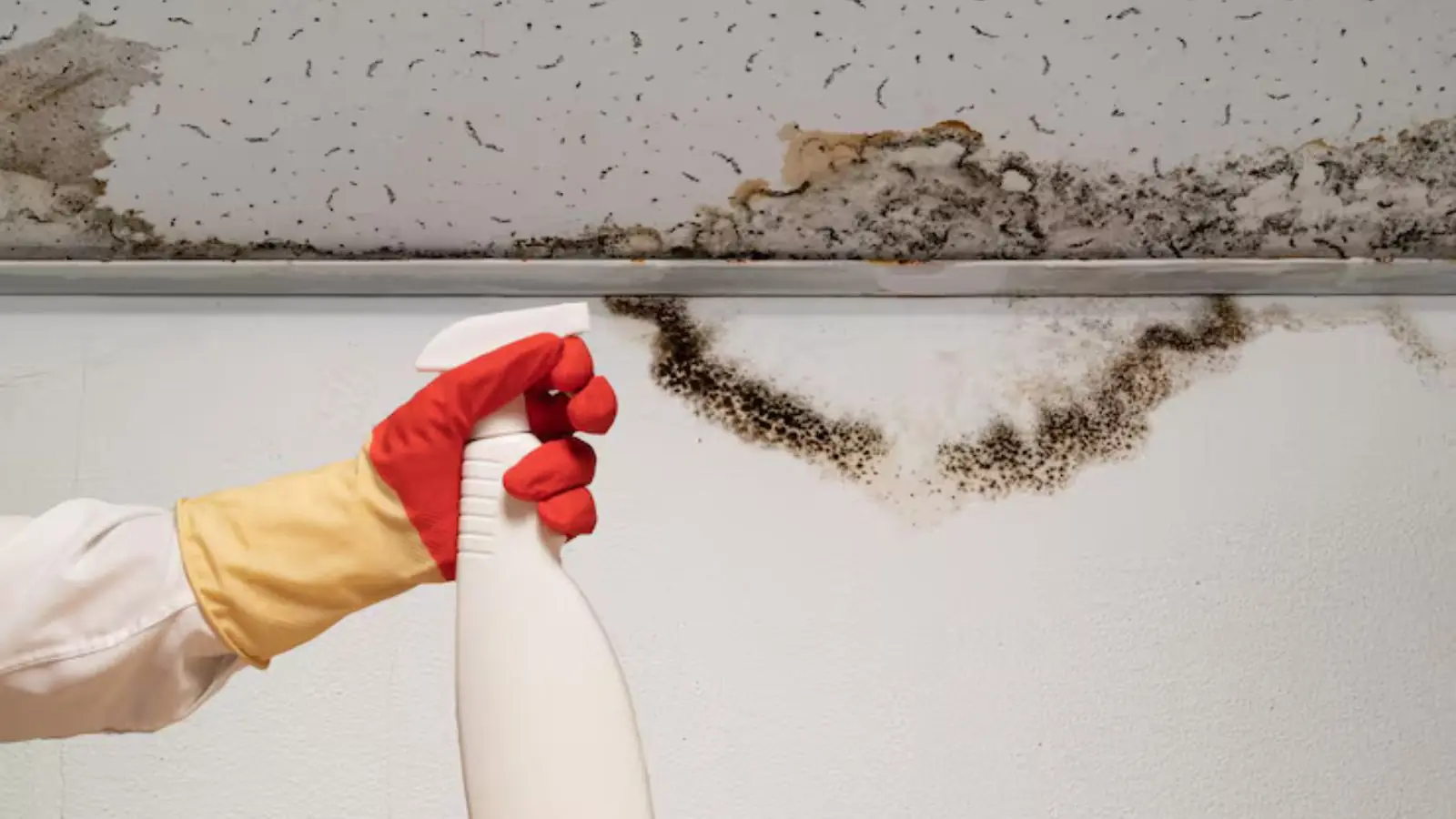
Learning how to remove mold from a bathroom ceiling in Duarte, CA starts with one question. Is the moisture coming from the room, or from above it? Steam from showers leaves a film on a ceiling that has poor airflow. A leaking supply line, a failing tub drain or a roof drip leaves a stain that keeps coming back.
Clean a small surface patch the right way and fix the humidity, and the problem usually stays solved. Clean over a hidden leak and the stain returns in weeks. The steps below separate the two and tell you where to stop and call.
Humidity or a hidden leak
Check the pattern before you pick up a sponge. The two causes look different if you know what to look for.
| What you see | Likely humidity | Likely hidden leak |
|---|---|---|
| Location | Spread over the ceiling, corners, near the fan or the shower | One concentrated spot, often under a wall, tub or bathroom above |
| Texture | Dots or thin film that wipes away | Brown ring, bubbling paint, soft or sagging drywall |
| Timing | Worse after showers, better in dry weeks | Stays the same or grows even when no one showers |
| Smell | Faint, steamy | Stale or musty even when the room is dry |
| Next move | Clean and improve ventilation | Stop, find the source, call a crew |
Press gently on the ceiling around the stain. If it feels soft, spongy or cold, the drywall is wet and cleaning is not the answer. A crew uses a moisture meter and a thermal camera to check without opening anything, which is far less guesswork than poking at it with a screwdriver.
Fix the ventilation first
Mold on a bathroom ceiling is a moisture problem, not a dirt problem. The EPA says moisture control is the key to mold control, so no cleaner will hold if the room stays damp. Look at three things.
- The exhaust fan. Does it pull a tissue to the grille? A fan that is weak, clogged with lint or vented into the attic instead of outdoors leaves steam in the room.
- Run time. Leave the fan on for a while after the shower ends, not just while the water runs.
- The door and window. Open them if you have no fan, and wipe water off tile and glass so it does not evaporate into the room.
If the fan is dead, replacing it is a normal repair. If the ceiling drywall is damaged and has to be cut out, see the permit note below before you start.
How to clean a small patch safely
The EPA advises fixing the water problem and drying everything completely, and its cleaning guidance for small areas uses detergent and water. You do not need bleach blends or a specialty product to start. Stick to the basics.
Protect yourself before you scrub
Wear disposable gloves, goggles that seal around your eyes, and an N95-type mask that fits snugly. Keep the bathroom door closed and run the fan if it works. Do not mix cleaning products. If you feel dizzy or short of breath, stop and get fresh air. Health questions belong with your physician.
- Cover the floor and fixtures. Lay a plastic sheet or old towels so debris does not land in the tub.
- Mix detergent and water. A small amount of dish detergent in a bucket of warm water is enough.
- Wipe, do not spray. Dampen a cloth, wipe the patch from the edge inward, and rinse the cloth often. Heavy spraying soaks the paint and drywall.
- Dry the area completely. Wipe with a clean dry cloth and run the fan or a small fan on low until the surface is dry to the touch.
- Bag the cloths. Seal them in a plastic bag and throw them out. Wash your hands and wash your clothes.
- Watch it for two weeks. If the spots return in the same place, the moisture source is still there.
Scrubbing hard or sanding a painted ceiling creates dust and can drive spores into the room. A gentle wipe is the rule. Painted drywall that has gone soft, or paper facing that peels away, cannot be cleaned and needs to be removed.
Not sure if it is humidity or a leak?
If the stain is brown, soft, spreading or keeps returning, stop cleaning. Call and describe it. A crew can read moisture behind the paint without cutting into it.
When to stop and call
Some bathroom ceilings are beyond a bucket and a cloth. Call a crew when any of these apply.
- The patch is larger than you can reach and wipe comfortably in one sitting.
- The ceiling is sagging, bubbling or stained brown.
- The stain sits under another bathroom, a roof, or a supply line.
- You smell mold but see nothing, or it returns after you cleaned.
- Water ever dripped from a light fixture or fan housing. Turn off the circuit and keep clear.
Our mold remediation crew works with containment so dust stays out of the rest of the house, and the first goal is always to find the water. Homes in Arcadia and Glendora share the same steamy bathroom problem, and the same stop and call signs apply there.
Duarte local note: no state mold license, and a permit for drywall
California has no legal requirement for training, licensing or certification of mold assessors or remediators, according to CDPH, and there are no state indoor mold exposure limits. So if you hire help, ask what standard the company follows and ask for a written scope. S520 is the published industry standard for mold remediation.
If the ceiling drywall has to come out, the City of Duarte says a building permit is required for drywall replacement. Call the Community Development counter at City Hall, 1600 Huntington Drive, at (626) 357-7931 ext. 230 or 235. City Hall is open Monday to Thursday and closed Fridays, so plan the call early in the week.
Sources: CDPH, city website, EPA, IICRC
Keeping it from coming back
If the stain turns out to be a leak, the structure above the ceiling has to be dried too, and that work falls under water mitigation. Opening a small inspection hole is sometimes enough to see whether insulation above is wet.
After the ceiling is clean and dry, keep it that way. Wipe the shower walls after use, wash the fan grille twice a year, and use a mildew resistant paint when you repaint, once the drywall is confirmed dry. Do not caulk over a patch that has not dried. If the tub or shower base leaks, repair the plumbing before touching the ceiling.
Questions Duarte homeowners ask
A small surface patch on a hard, painted ceiling can be cleaned with detergent and water, then dried completely. Use gloves, goggles and an N95-type mask, and stop if the ceiling is soft or the patch keeps returning.
Because the moisture source is still there. Weak ventilation, a leak above the ceiling or a damp cavity will bring the stain back in weeks. Fix the water problem first and dry everything fully.
The City of Duarte says a building permit is required for drywall replacement. Call the Community Development counter at (626) 357-7931 ext. 230 or 235 to confirm what applies to your job.
For a small patch, the EPA's guidance centers on detergent and water and thorough drying. Adding other products raises the risk of mixing chemicals and does not fix the moisture.
Call when the ceiling is soft, sagging or brown, the patch is large, the stain sits under plumbing or a roof, or it comes back after cleaning. Those signs point to hidden moisture.